


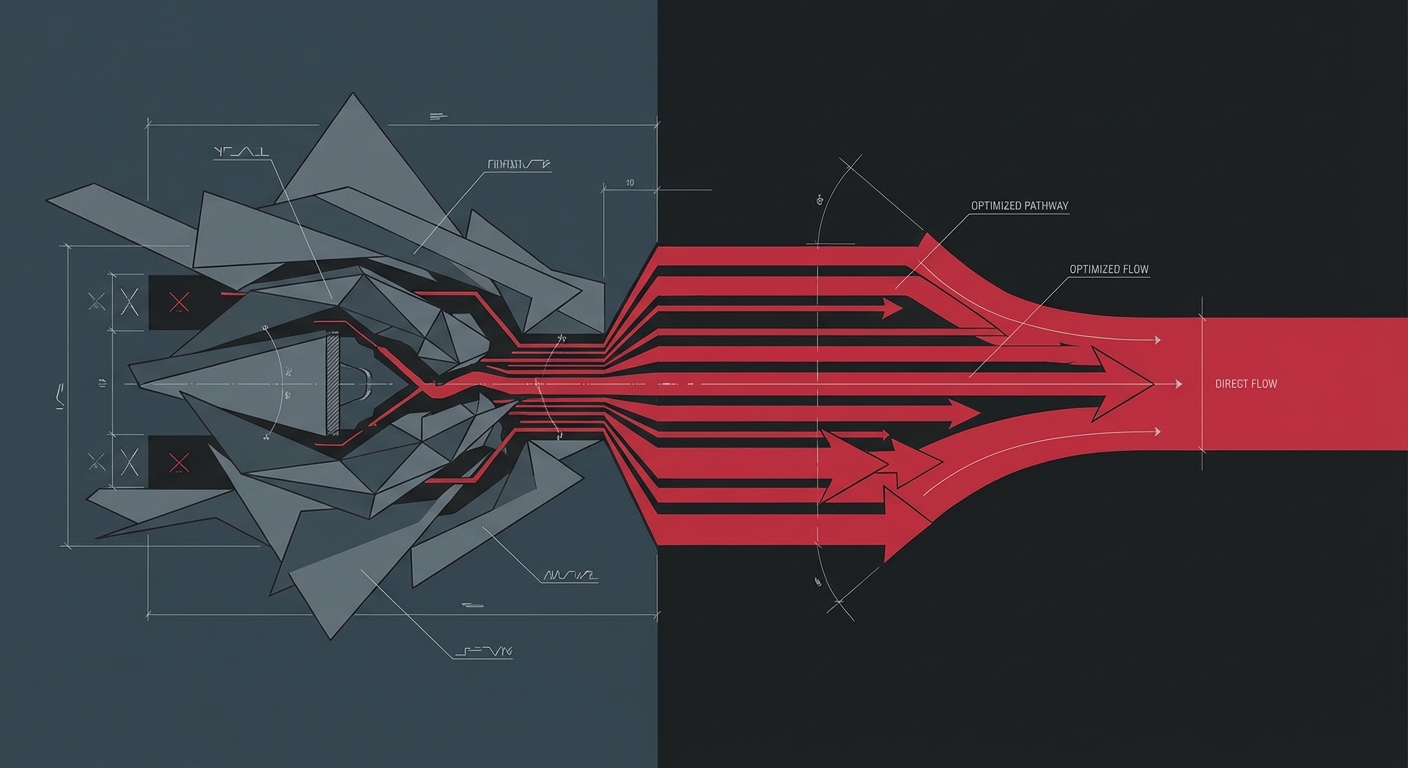
There is a pattern in software organizations so common it has earned its own name: the feature factory. You know the symptoms. Backlogs measured in hundreds of tickets. Velocity tracked in story points. Success defined by throughput, how many features shipped this sprint, not by whether any of them moved a business metric.
The feature factory is not a sign of dysfunction. It is a rational adaptation to a constraint that used to be real: implementation was the bottleneck. When every feature required a human to write every line of code, test it manually, and shepherd it through a multi-week deployment process, optimizing for throughput made sense. You could not ship outcomes if you could not ship code, and shipping code was hard and slow.
That constraint is dissolving. AI agents can now handle significant portions of implementation, testing, and deployment verification. The bottleneck has moved. And when the bottleneck moves, the entire organizational model optimized around the old bottleneck becomes a liability.
The feature factory is dying. What replaces it is outcome-oriented engineering, and the transition is already underway.
How We Got Here
The feature factory emerged from a reasonable misapplication of agile principles. Agile told us to ship incrementally, get feedback, and iterate. The industry heard “ship more, faster” and built organizations around that interpretation.
Story points became the currency. Sprint velocity became the performance metric. Backlog size became a proxy for ambition. Product managers became ticket generators. Engineers became ticket consumers. The entire machinery oriented itself around transforming requirements into deployed code as efficiently as possible.
The problem is that none of this measured whether the deployed code did anything useful. You could have perfect velocity, zero missed sprints, a pristine burndown chart, and still build a product that failed in the market because nobody checked whether the features you shipped moved the metrics that mattered.
We have watched this pattern play out across engagements with companies of every size. A team ships forty features in a quarter, feels productive, and then discovers that the three features that actually drove user engagement were built despite the process, not because of it. The other thirty-seven features sit in the codebase generating maintenance cost and zero value.
This is the feature factory at work. High throughput. Low impact. Excellent process metrics. Mediocre business outcomes.
Why AI Kills the Feature Factory
The feature factory survived because implementation was expensive enough that you needed to optimize for it. If every feature costs weeks of developer time, you need a system that keeps developers busy on the highest-priority items. Story points, sprint planning, and velocity tracking are all mechanisms for managing expensive human implementation capacity.
AI agents change the economics. When an agent can generate a working implementation from a well-written spec in hours instead of weeks, the cost of implementation drops dramatically. And when implementation becomes cheap, optimizing for implementation throughput stops making sense.
Think about it this way: in a feature factory, the scarce resource is developer time, so you manage it carefully. In an AI-native organization, the scarce resource is outcome clarity, knowing exactly what to build and why, so you manage that instead.
This is not a minor adjustment. It is a fundamental reorientation of where organizational attention and leadership focus should go.
The Old Bottleneck: Can We Build It?
In the feature factory model, the critical question was capacity. Do we have enough developers? Can we get this done in the sprint? What is the effort estimate? The entire planning apparatus, sprint planning, grooming, estimation poker, was designed to answer the question: given our limited capacity, what should we build next?
The New Bottleneck: Should We Build It?
In an AI-native model, the critical question is clarity. What outcome are we trying to achieve? How will we measure it? What is the minimum build that tests our hypothesis? The planning apparatus needs to answer a different question: given our ability to build almost anything quickly, what is the highest-value thing to build right now?
This is a much harder question. It requires deeper product thinking, better data, and more rigorous outcome definition than most feature factories have ever needed.
What Outcome-Oriented Engineering Looks Like
Here is what changes when you abandon the feature factory for outcome-oriented engineering:
Work Units Change
In a feature factory, the unit of work is a ticket, typically a user story with acceptance criteria and an estimate. In outcome-oriented engineering, the unit of work is an outcome hypothesis: “We believe that building X will move metric Y by Z amount within T timeframe.”
Each outcome hypothesis includes:
- The target metric (specific, measurable, currently tracked)
- The proposed intervention (what we will build or change)
- The expected impact (quantified or at minimum directional)
- The validation method (how we will know if it worked)
- The time horizon (when we expect to see results)
This is a more demanding unit of work than a user story. It requires product teams to think rigorously about causation, not just correlation. But it also means every piece of engineering work has a clear reason for existing and a clear method for evaluating its success.
Team Roles Change
The feature factory team has a product manager who writes stories, developers who implement them, and QA who tests them. It is a linear pipeline: define, build, verify.
The outcome-oriented team has different roles:
- Outcome Owners who define the business metrics and success criteria
- Context Engineers who translate outcome definitions into specifications precise enough for agent consumption
- System Architects who design the technical approach and integration points
- Review Engineers who validate agent output against specifications and ensure production readiness
Notice what is different: the heaviest investment is at the front of the pipeline (defining outcomes and specifications) and the back of the pipeline (validating results), not in the middle (implementation). Agents handle the middle. Humans handle the parts that require judgment, domain knowledge, and strategic thinking.
Metrics Change
Feature factories measure velocity, throughput, and cycle time. These are all activity metrics. They tell you how busy the team is, not how effective.
Outcome-oriented teams measure:
- Outcome hit rate: What percentage of outcome hypotheses achieved their target metric within the defined time horizon?
- Time-to-impact: How long from outcome definition to measurable metric movement?
- Outcome efficiency: What was the engineering investment required to achieve each successful outcome?
- Learning velocity: How quickly does the team update its approach based on outcome data?
These metrics are harder to game and more meaningful to the business. A team with 50% outcome hit rate and 10-day time-to-impact is delivering more value than a team with perfect sprint velocity that never checks whether its features matter.
Planning Cadence Changes
Sprint planning in a feature factory is a scheduling exercise: what fits in the next two weeks? Planning in an outcome-oriented team is a prioritization exercise: which outcome hypotheses have the highest expected value given current data?
The planning cadence also accelerates. Because AI-native delivery compresses implementation timelines, outcome-oriented teams can run shorter experiment cycles. Instead of planning quarterly and reviewing annually, they plan monthly and review weekly. Some teams plan weekly and review daily. The right cadence depends on the domain, but it is almost always faster than what the feature factory supported.
Making the Transition
Abandoning the feature factory is uncomfortable. The rituals of sprint planning, backlog grooming, and velocity tracking feel productive. They give teams a sense of control and progress. Replacing them with outcome-oriented practices feels riskier because the feedback is less frequent (you do not get the dopamine hit of closing tickets every sprint) but more meaningful.
Here is a practical transition path:
Step 1: Run the Outcome Audit. Take your last quarter’s shipped features. For each one, identify what business metric it was supposed to improve and whether it actually did. Be honest. In most feature factories, fewer than 30% of shipped features have a clear metric connection, and fewer than 10% have measured impact data. This audit makes the case for change.
Step 2: Pilot One Outcome Team. Take a single team and restructure it around outcome-oriented practices. Give them one business metric to move. Let them define their own approach, run their own experiments, and measure their own results. Do not constrain them with sprint ceremonies or velocity targets. Give them the freedom to operate differently and the accountability to show results.
Step 3: Invest in Specification Discipline. The biggest gap most teams encounter when transitioning is specification quality. Feature factory specs (user stories) are not rigorous enough for outcome-oriented work, and they are not precise enough for agent consumption. Invest in training your team to write formal specifications. This is the single highest-leverage skill for the transition.
Step 4: Deploy AI-Native Tooling. Give the outcome team access to AI-native development tools and methodologies. At CONFLICT, we use our HiVE methodology and CalliopeAI workbench for this, but the key is moving from IDE-based, human-only development to a model where agents handle implementation under human direction.
Step 5: Measure and Expand. Compare the outcome team’s results to the feature factory teams. Measure what matters: business metric movement, time-to-impact, engineering cost per outcome. If the outcome team outperforms (and in our experience, it will), use the data to expand the model.
The Cultural Shift
The hardest part of killing the feature factory is not the process change. It is the cultural change. Feature factories are comfortable because they provide clear measures of individual and team productivity. Story points completed. Tickets closed. Pull requests merged. Everyone can point to their output.
Outcome-oriented engineering is less comfortable because it measures collective impact, not individual output. A team might spend a week defining the right outcome and writing precise specifications, then ship the solution in a day with agent assistance. In a feature factory culture, that looks like a slow week followed by one productive day. In an outcome-oriented culture, it is a smart week that led to a high-value delivery.
Leaders need to actively reshape what “productive” means. Thinking is productive. Specifying is productive. Validating is productive. Typing code was never the point; it was the bottleneck masquerading as the goal.
Where This Leads
The death of the feature factory is not a trend. It is a consequence of a fundamental shift in the economics of software delivery. When implementation is no longer the bottleneck, organizations optimized for implementation throughput lose their advantage.
What replaces the feature factory is not chaos. It is a more rigorous, more accountable, more impactful way of building software. Outcome-oriented engineering demands better thinking, better specifications, and better measurement than the feature factory ever required. But it delivers something the feature factory never could: a direct, measurable connection between engineering investment and business results.
The teams that make this transition will outperform. Not because they ship more features, but because every feature they ship is aimed at a specific outcome, measured against a specific metric, and iterated based on specific evidence. That is the discipline that replaces the factory. And it is a significant upgrade.