


There is a recurring fantasy in AI discourse that goes something like this: once the model is good enough, you will not need a human in the loop anymore. The system will just handle it. This is wrong, and building production AI systems on this assumption is how companies end up with expensive, untrustworthy tools that nobody uses.
Human oversight in AI systems is not a stopgap for bad models. It is a fundamental design requirement. The question was never whether to include humans in the loop. The question is where, how often, and with what mechanisms.
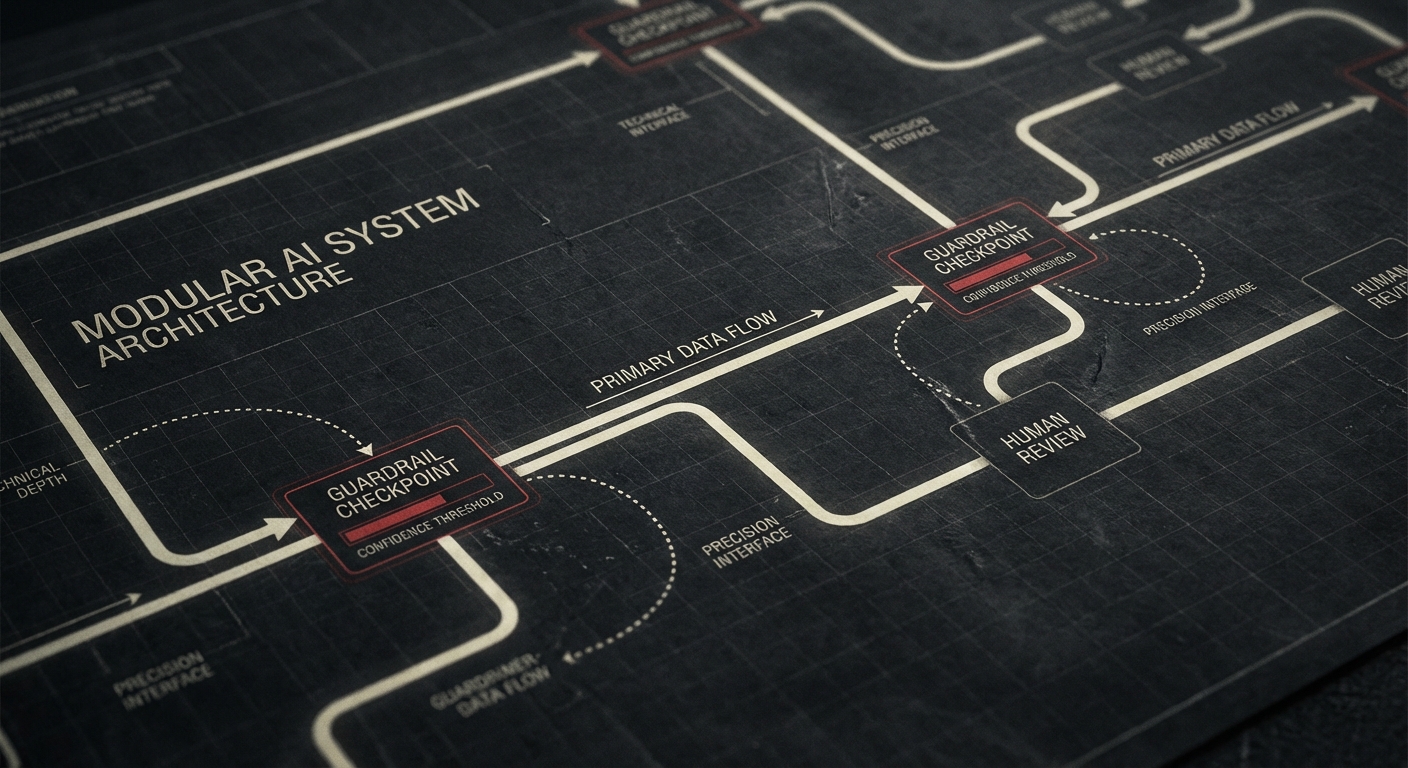
At CONFLICT, every agentic system we build ships with explicit human checkpoints designed into the architecture. Not because the models are unreliable, but because the stakes of the decisions these systems make demand it. When an AI agent is processing insurance claims, routing customer requests, or making infrastructure changes, the cost of a wrong action can far exceed the cost of a brief human review.
The Confidence Threshold Pattern
The simplest and most effective guardrail pattern is the confidence threshold. Every AI action in a pipeline produces some signal about how certain it is. This might be a literal confidence score, a log probability, or a derived metric from your evaluation layer. The pattern is straightforward:
- High confidence, low stakes: Execute automatically. Log the decision for audit.
- High confidence, high stakes: Execute with notification. A human can review after the fact.
- Low confidence, low stakes: Execute with a flag. Queue for batch review.
- Low confidence, high stakes: Stop. Route to a human. Do not proceed until approved.
The two axes here – confidence and stakes – create a matrix that governs your entire automation strategy. Most teams get this wrong by treating everything as the same category. Either they automate everything (and get burned by edge cases) or they require human review on everything (and the system becomes a bottleneck that people start ignoring).
Defining the stakes axis requires domain knowledge. In a customer service agent, “change shipping address” is low stakes. “Issue a refund over $500” is high stakes. In an infrastructure automation system, “scale up a read replica” is low stakes. “Modify a production database schema” is high stakes. Your product and engineering teams need to map these categories explicitly during system design, not after deployment.
class ActionClassifier:
    def __init__(self, stakes_map: dict, confidence_threshold: float = 0.85):
        self.stakes_map = stakes_map
        self.confidence_threshold = confidence_threshold

    def classify(self, action: str, confidence: float) -> str:
        stakes = self.stakes_map.get(action, "high")  # Default to high stakes

        if confidence >= self.confidence_threshold and stakes == "low":
            return "auto_execute"
        elif confidence >= self.confidence_threshold and stakes == "high":
            return "execute_with_notification"
        elif confidence < self.confidence_threshold and stakes == "low":
            return "execute_and_flag"
        else:
            return "require_human_approval"
The default-to-high-stakes pattern in that code is intentional. When an action is not explicitly mapped, the system should assume the worst. This is the opposite of how most prototype systems work, where unknown actions default to automatic execution.
Approval Workflows That People Actually Use
The second pattern failure is building approval workflows that are technically correct but practically useless. If your human-in-the-loop system sends a Slack message with a wall of JSON and expects someone to click “approve” within 30 seconds, you have not built a guardrail. You have built a rubber stamp.
Effective approval workflows share three characteristics:
They provide context, not data. The human reviewer needs to understand what the system wants to do, why it wants to do it, and what the consequences are. Raw model outputs, token probabilities, and retrieval scores are useful for debugging but useless for decision-making. Translate the system’s reasoning into a format that maps to the reviewer’s mental model.
They are asynchronous by default. Not every decision needs to happen in real time. For many use cases, a queue-based approval system where reviewers process decisions in batches is more reliable and less fatiguing than real-time interrupts. The system should be designed to wait gracefully. This means your pipeline architecture needs to support pausing, checkpointing, and resuming – which is a pattern we will cover in a separate article on checkpoint/resume.
They have escalation paths. If a reviewer is unsure, there needs to be an explicit “I don’t know, escalate this” option. Without it, uncertain reviewers will either approve everything (to clear the queue) or reject everything (to avoid risk). Neither behavior is useful. Escalation chains should be defined in advance, with clear ownership at each level.
We have seen this play out in client engagements repeatedly. One organization built a sophisticated document classification system with a human review step. The review interface showed the document, the model’s classification, and a confidence score. Reviewers approved 98% of decisions within two seconds. When we audited the results, the error rate on human-reviewed items was identical to the error rate on auto-classified items. The review step was adding latency without adding value. The fix was not removing the human – it was redesigning the interface to highlight the cases where human judgment actually mattered: ambiguous documents, edge cases, and items where the model’s top two classifications were close in score.
Escalation Chains
An escalation chain defines who handles decisions at each level of uncertainty or impact. This is not a new concept – incident management has used escalation chains for decades. But applying it to AI systems requires some adaptation.
A typical escalation chain for an AI-powered system looks like this:
- Level 0: Automatic execution. The system acts within its defined parameters. All actions are logged.
- Level 1: Domain expert review. A subject matter expert reviews the proposed action. This is your first human checkpoint.
- Level 2: Team lead review. For actions that have cross-functional impact or exceed the domain expert’s authority.
- Level 3: Policy review. For actions that touch compliance, legal, or regulatory boundaries.
- Level 4: Emergency stop. A kill switch that halts all automated actions pending a full review.
Each level should have defined SLAs. If Level 1 does not respond within a specified window, the system should escalate to Level 2, not auto-approve. The temptation to add auto-approval timeouts is strong – resist it. An unanswered escalation is a signal that your process is broken, not that the action should proceed.
escalation_chain:
  - level: 0
    action: auto_execute
    condition: "confidence >= 0.95 AND stakes == 'low'"
    logging: full_audit_trail

  - level: 1
    action: domain_expert_review
    condition: "confidence >= 0.85 AND stakes == 'medium'"
    sla_minutes: 30
    timeout_action: escalate

  - level: 2
    action: team_lead_review
    condition: "confidence < 0.85 OR stakes == 'high'"
    sla_minutes: 60
    timeout_action: escalate

  - level: 3
    action: policy_review
    condition: "regulatory_flag == true"
    sla_minutes: 240
    timeout_action: halt_pipeline
Rollback Mechanisms
Every automated action should be reversible. This sounds obvious, but in practice, most AI systems are designed for the happy path. They know how to take actions but not how to undo them.
Rollback mechanisms fall into three categories:
Transactional rollback. The action is wrapped in a transaction that can be reversed atomically. This works for database operations, API calls with undo endpoints, and configuration changes managed through version control. The system records the pre-action state and can restore it.
Compensating actions. When true rollback is not possible, the system executes a compensating action that reverses the effect. If the system sent an email, it sends a correction. If it updated a record, it logs an amendment. This is messier but necessary for actions with external side effects.
Audit and manual recovery. For truly irreversible actions (sending a notification to 10,000 users, for example), the rollback mechanism is an audit trail detailed enough for a human to understand what happened and take corrective action. This is the last resort, and if your system has many actions in this category, you should reconsider your automation boundaries.
The key design principle is that the rollback mechanism must be designed and tested before the forward action is deployed. Not after. Not when something goes wrong. Before.
Designing for Degradation
Production AI systems fail in ways that traditional software does not. Models drift. Provider APIs go down. Embedding quality degrades as your data changes. Prompt performance varies as models get updated. These are not edge cases – they are normal operating conditions.
Your guardrail system needs to handle degradation gracefully. This means:
Monitoring model performance continuously. Track key metrics (accuracy, latency, confidence distribution) against baselines. When performance degrades beyond a threshold, automatically tighten the confidence thresholds. If your model normally operates at 92% accuracy and drops to 85%, the system should shift more decisions to human review without requiring a deployment.
Circuit breakers for AI components. Borrow from distributed systems engineering. If your AI component fails repeatedly or produces anomalous outputs, trip a circuit breaker that routes all traffic to the human fallback path. This prevents cascade failures where a degraded model makes bad decisions that trigger downstream errors.
Graceful capability reduction. When the AI system is partially degraded, reduce its autonomy rather than shutting it down entirely. A customer service agent that cannot reliably classify intent can still route all conversations to human agents with a suggested classification. The human does more work, but the system stays operational.
At CONFLICT, we built these patterns into our internal methodology. Our Firedrill tool specifically tests AI system degradation scenarios – what happens when your model provider has a latency spike, when embedding quality drops, when a prompt that worked last week produces garbage today. The teams that survive these scenarios are the ones that designed their guardrails to scale down, not just up.
The Governance Layer
At organizational scale, individual guardrails need to roll up into a governance framework. This is not about compliance theater – it is about maintaining visibility and control as AI systems proliferate across teams.
A practical governance layer includes:
A registry of all AI-powered actions. Every automated action across every system should be cataloged with its stakes classification, confidence thresholds, escalation chain, and rollback mechanism. When a new regulation drops or a model provider changes their terms, you need to know what is affected.
Audit trails that are queryable, not just archivable. Logging every AI decision to a file is not governance. You need to be able to answer questions like: “How many high-stakes decisions were auto-approved last month?” and “Which actions had the highest override rate?” These queries inform your threshold tuning and process improvements.
Regular threshold reviews. Confidence thresholds should not be set-and-forget. As models improve, thresholds can be relaxed. As your domain changes, they may need to tighten. Schedule quarterly reviews of your automation boundaries, informed by actual performance data.
Human reviewer performance tracking. This is the one nobody wants to talk about. If you are routing decisions to humans, you need to measure whether those humans are adding value. Track agreement rate between human decisions and model suggestions. Track time-to-decision. Track error rates on human-reviewed items versus auto-approved items. If the data shows that human review is not improving outcomes for a particular action class, adjust the threshold so that class auto-executes, and redirect human attention to where it matters.
The Scaling Problem
The real challenge with human-in-the-loop systems is not building them – it is scaling them. As your AI system handles more volume, the number of items requiring human review grows. If 5% of your actions need human review and you process 100 actions a day, that is 5 reviews. If you process 100,000 actions a day, that is 5,000 reviews. Your human review capacity does not scale linearly with your AI throughput.
Three strategies address this:
Continuous threshold optimization. As you collect more data on which items humans approve, reject, or modify, use that data to refine your thresholds. The goal is to reduce the review rate without increasing the error rate. This is a machine learning problem in its own right, and it is worth investing in.
Tiered review pools. Not every reviewer needs to handle every type of decision. Build specialized review queues with trained reviewers for each domain. This increases throughput and accuracy simultaneously.
AI-assisted review. Use AI to help humans review AI. Surface the relevant context, highlight anomalies, pre-populate decisions with suggestions. The human is still the decision-maker, but the AI reduces the cognitive load per decision. This is not circular – it is layered. The review AI and the action AI should be independent systems with different failure modes.
What This Looks Like in Practice
We recently built a document processing system for a client that handles thousands of insurance claims daily. The system extracts data from submitted documents, classifies claim types, and routes them to appropriate adjusters.
The guardrail system works on three layers. The extraction layer uses confidence thresholds to flag low-confidence extractions for manual verification. The classification layer uses a combination of confidence scores and business rules – any claim over a certain dollar amount goes to senior review regardless of model confidence. The routing layer has an escalation chain that triggers when processing times exceed SLAs or when the system detects unusual patterns in claim submissions.
The result: 78% of claims process without human intervention. The remaining 22% are routed to the right human at the right time with the right context. The system processes 4x the volume of the previous manual process with lower error rates and faster turnaround times.
That is not a story about AI replacing humans. It is a story about AI and humans working together through a deliberately designed system. The guardrails are not a limitation on the AI. They are what make the AI trustworthy enough to deploy at scale.
Human-in-the-loop is not a phase you graduate from. It is an architecture you invest in.